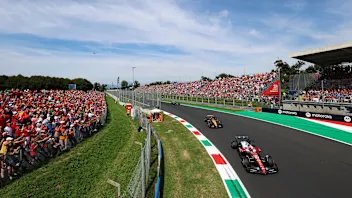
Formula 1 returns to action with the Italian Grand Prix this weekend. But how much do you know about the Autodromo Nazionale Monza? F1.com presents your all-in-one guide…
When was Monza’s first Grand Prix?
Constructed in just 110 days in 1922, the Autodromo Nazionale Monza was the world’s third purpose-built race track, coming after Brooklands in the UK and Indianapolis in the US.
Like those two tracks, the original Monza circuit featured a daunting series of banked curves, as well as much of the ‘outfield’ section that’s still in use today.
Monza opened its doors on September 3 1922, just a week before it hosted that year’s Italian Grand Prix. It was then part of the original F1 calendar in 1950, and has held the Italian Grand Prix every year bar one since.
What’s the circuit like to drive?
Red Bull driver Max Verstappen’s 264kph average speed during his 2025 pole lap (more on that below) should give you some idea of the nature of the track that locals call ‘La Pista Magica’.
Cars are on full throttle for 80% of the lap, and hit their Vmax on the circuit’s 1.1km start/finish straight. From there, they roar off into the historic park section, where a series of big stops into tight chicanes give the brakes a good workout.
So, just how do drivers approach the unique challenge of racing at Monza?
“Monza is one of a kind on the calendar, yet in many ways is the simplest track,” says former Renault F1 driver Jolyon Palmer. “It’s low downforce and all begins with braking into the chicane for Sector 1 and getting your car to stop as nicely as you can for Turn 1 - that’s the key.
“In the middle sector, the Lesmos are actually more fun to drive than they look, with a slight camber. You can carry a bit of speed in, pick your line for a little brake and again through Lesmo 2.
“Gravel can greet you if you carry too much speed into Turn 8/9/10 at Ascari - the first part of the corner is the crucial area - but it’s quite bumpy as well. Then stay pinned through 9 and 10, if you get 8 right, which takes you to Parabolica or Curva Alboreto (renamed after the late Michele Alboreto).
“Sadly, they took away the gravel that was the charm of this final corner, but it’s still a cool challenge - attack it, run right around the outside to carry speed, get on the throttle as soon as possible and charge onto the main straight.
“It used to be perilous with the gravel on the outside, whereas now a little bit of the exhilaration is maybe taken away with the tarmac run-off, but it’s still possible to crash and Monza is still a fantastic high-speed circuit.”
Where are the Straight Mode zones and overtake detection?
As a reminder, and as explained in our pre-season summary of regulation changes, Straight Mode is a different aerodynamic configuration that allows cars to reduce their drag, making them more efficient when accelerating up towards top speed.
The rear wing continues to open up a gap - just like it did when drivers used DRS (the Drag Reduction System) in the past - but now the front wing also moves. The uppermost front wing elements drop down at the same time the rear wing’s top element does.
This is a mode that is used on every single lap in dry conditions, in every area that is designated for it. Essentially, the car will adapt between two different configurations depending on where it is on the track, providing maximum downforce in corners but then less drag on straights.
At Monza, there are four designated Straight Mode zones: a run along the start/finish straight, followed by the sections between Turns 3 and 4, Turns 7 and 8, and Turns 10 and 11.
Meanwhile, Overtake Mode replaces DRS and is a new power mode that allows a driver to recharge more electrical energy, and generate an additional electrical power profile, so they can sustain a higher speed for a longer period.
There is one detection point per lap for this mode - expected to be out of the final corner on many occasions, leading onto a long straight - and it will be available to drivers on the following lap as long as they stay within a second of the car in front at that detection point.
The Overtake Detection marker here comes just before the entry to Turn 11, while the Overtake Activation line follows on the exit of that corner, heading onto the start/finish straight.